Showing posts with label emanuel syndrome. Show all posts

Wednesday, 16 November 2022

A Favourite Christmas Memory of Steven


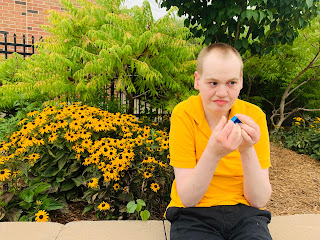
My favorite memory of Steven was the day he "let go" and walked independently for the first time. It was Christmas Eve, 22 years ago in the year 2000. We were spending Christmas with Sherry's family in Barrie, Ontario. There wasn't much space for Steven to move around in his walker at Grandma's house. He used a large square metal frame walker, with castors at the four corners of the base, and with a padded hoop around his chest. He was pretty good at scooting around our house in it, but Grandma's didn't have much space.


We bundled up and I drove over to the local shopping mall for some exercise. At that time Steven would walk pretty well as long as I held one hand or the other, or both. His balance was not great, and with the rigid AFO's his gait was quite akin to Frankenstein. I needed to be alert for any changes in grade, floor texture, floor colour, metal thresholds, sidewalk cracks and steps-because Steven was unable to distinguish such changes as being hazardous. When walking him and such a change was at hand, we would stop and provide a cue to step over or up carefully. Being Christmas Eve, the mall was quite busy with last-minute shoppers. After parking, Steven and I walked through the slushy parking lot and into the mall. Once inside I had him sit on a bench to remove his snow boots and coat and put them in the backpack.

Prior to that day, Steven had never taken independent steps. On this day, however, Steven was more inquisitive than usual. For some reason, the circular racks of clothing on sale for Christmas drew his attention, and he would pull me towards them so he could look closely at the colours, feel the textures, and touch the tags. If there was any back-lit signage he would pull me over to touch and tap them- such was his pleasure.

As we walked along I hoped to avoid a particular clothing rack that held some more expensive items and began leading Steven around it in a wide arc. Surprisingly, he shook away my hand and took two tentative steps toward his target before I got ahold of his hand again. I thought he had done this intentionally, but I wasn't sure.
It was getting close to suppertime so we worked our way back to the mall entrance. Along the way, he again shook away my hand to step toward something. This again seemed intentional, but I wasn't sure.

I parked Steven on the bench and got his snow boots, winter coat, and toque on him. Directly across from this bench was situated a brightly lit Jewelry store. As soon as I got Steven to his feet, he was off, all on his own, towards that store entrance. When he had crossed the tiled floor of the mall, he stopped at the point where the tile ended and the carpet of the Jewelry store began. Steven carefully raised his left foot and stepped onto the carpet, as if it may have represented a change in height. Steven then took three more careful independent steps and slapped his hands on the glass display case filled with bright, beautiful shining trinkets. He also put his drooling face on the glass and smiled with joy.
I will always remember that Christmas Eve as the day Steven achieved his greatest skill, and with it, the ability to explore, to choose, and to communicate his wishes.

Steven still wanders off when he's out with me, if only for a few steps on his own. His support workers get kind of freaked out when he wanders from the cart at Walmart or the grocery store. But for me, it still makes me so very proud and happy for Steven, and as long as he is able I want him to enjoy this taste of freedom.
Thank you Steven for this gift, my favorite Christmas memory.

Meet James: Living with Emanuel Syndrome


James Desmond Holt was born in 2015 on the dynamic day of the Autumn Equinox. He was so little and so beautiful! It was hard to believe that within the first 2 weeks of his life he would be diagnosed with Emmanuel Syndrome, poked and prodded by countless specialists, and undergo his first (of 9) surgeries. 


The first year involved weekly doctor appointments and therapy sessions. We watched our perfect boy grow, learn and experience this world. We vowed to do everything we could to help him reach his potential. But, the biggest surprise of all is how much we learned from him - unconditional love, strength, perseverance and our own potential with the human experience. 


He is the center of our hearts and desires, and without him we, his mom, dad and little sister, would not be a family. He is our fearless leader into the unknown, defying every single odd they throw at us and charming all that meet him. Today he not only walks and talks, but he runs, jumps, climbs, sings and dances. He laughs and shrieks, cries and sticks out his lower lip when he's sad. You know he loves you when he hugs you and blows you kisses.

-Karen

Tuesday, 15 November 2022

Meet Quin


My name is Quin. I have Emanuel syndrome. I am 6 years old and live with my dad, mom and little brother Stef in the Netherlands.

I'm always happy and I like to play with my family.

If you want you can follow me on Facebook and Instagram @Quintanis. There I share what I experience in daily life.

Love, Quin

Saturday, 12 November 2022

Joseph Tyler Phillips - Living with Emanuel Syndrome


My son, Tyler, was born (in 1992) before his genetic abnormality was even named!
When looking for information, I kept finding the same single page of minimal information. Then I found a support group on the very young internet. All information at the time was in print in the form of newsletters.

Tyler was different health-wise than most other children featured in the newsletter. I treated him as normally as possible, even with his obvious issues of being nonverbal and developmental delays.


He was diagnosed with leukemia in 2004. He was treated and is a survivor!

Fast forward to Facebook! 
I was reunited with the support group! Seeing the many other children like Tyler from around the world has been so amazing!

Comparing, discussing, and knowing we are not alone has been amazing! What a special family we have!


Tyler is now 30 years old! What a true miracle he is!

Thanks to Chromosome 22 Central!
-Allyson

Boris - Living with Emanuel Syndrome


Boris


Boris was born full term by section and we didn't realize anything was wrong until he refused to eat and his cleft palate was noticed. A day later he was rushed for life-saving surgery as it was found he has an imperforate anus. It was the longest and scariest day in my life, but he made it. 

We spent two months in the hospital and together with the palate he was also diagnosed with PFO, micrognathia, stridor post-intubation, airway abnormalities, duplex kidneys, and undescended testicles. A month after his birth he was diagnosed with Emanuel syndrome which explained everything. Last year Boris was admitted to the hospital once to have his peg placed as he is entirely fed by it and we are waiting for three surgeries in near future. He is currently one year and three months old and can't roll or sit independently but he smiles daily and brightens our lives.

-Mom


Kaysen - Living with Emanuel Syndrome


My son is Kaysen he is 7 years old. Kaysen is the strongest person I know. Every day no matter what is going on with him he has a smile on his face. We were told at about 20 weeks Kaysen would have Emanuel syndrome and my world came crashing down, But Kaysen quickly taught me the meaning of life and showed me real love, resilience, strength, faith, and much more! Kaysen can walk assisted and take steps unassisted, he can eat by mouth, and can communicate using pictures and eye gaze when he wants of course. I might be biased, but he is also so beautiful inside and out. 


You can find Kaysen pretty much always with his leg crossed, laughing at Mickey Mouse, or trying to convince someone to spin him around for thrills. I thank God every day for my amazing little man. I chose to share Kaysen with the world to be able to help a mom overcome their diagnosis or to help a family find the right diagnosis.
-Tracy

Nobody ever says, " I wanna be a special needs mom."


Nobody ever says, " I wanna be a special needs mom."
Except me.
I remember when it happened.
I was in the grocery store and a little developmentally disabled boy came walking in with his mommy.
He was smiling so big, swinging his held hand as he walked,
And he looked like he didn't have a worry in the world.
I remember looking at my husband and telling him that if G-d chose to bless us with a special needs child I would happily be their mother.
And then my son was born and I forget all about that.
I remember how stiff he was when we brought him home and how I knew from the first night that there was something "wrong."
I remember laying awake all night wondering what was going to happen to him,
Would he ever be "normal?"
Would he walk? Would he talk?
I made his story my victimhood.
I wished he was normal.
I wept for the loss of the babyhood of my last child.
I grieved the hard life he would inevitably have.
And then one day something changed.
One day I remembered that moment in the grocery store with that smiling boy, and I realized.
THIS IS MY SON.
He is a child with special needs and he was always going to be that.
That is who HE is and who he came here to be.
My son doesn't have special needs,
A special needs child is MY SON.
And it was at that moment that everything changed.
Instead of looking at him (and me) as a victim I started looking at us as a team.
A couple of souls solving a puzzle.
A puzzle of how to live a fulfilled life.
I started to celebrate his inchstones instead of mourning milestones.
I started to be grateful for the skills he gained and not the ones he was still struggling with.
CAN I JUST TELL YOU WHAT A DIFFERENCE THAT MADE?
What a shift I had simply loving who he was without trying to make him into something I wished he was?
Something I felt reflected poorly on me?
I wish I could tell you I no longer struggle with his struggle, but it wouldn't be true.
I still catch myself wondering what it would be like if he sat up or if he could talk.
I still slip into worry about what will happen to him when we are gone...
But those times are now fewer and far between,
As we settle into this greatest adventure of our lives.
and it isn't parenting a special needs child.
It's loving what is...
and being grateful for the gift of the journey
and of this precious magical little man who "calls" me mom.

-AmyLee

Wednesday, 16 March 2022

Atle - Living with Emanuel Syndrome

We were living in Saskatoon, Canada. It was Good Friday, April 9th, 1993 when our Atle decided to come into this world. He was such an easy delivery and everything seemed fine. He looked perfect. No obvious abnormalities, no problems initially. I was a bit worried because he didn’t latch on well to the breast but his older brother also took a while to get the hang of it so it wasn’t a big concern. They told me that his blood sugar was low the next morning so we stayed an extra day. But he still didn’t seem to be able to latch. He would paste his tongue up to the roof of his mouth leaving no room for the nipple. My brilliant husband figured out how to use one of those pacifiers with the hole in the back for your finger to force the tongue down so that we could slip the nipple in and get him to eat. Breastfeeding was not going to happen for this one apparently. So, we went home with the formula a bit disappointed but no big deal.

At home we noticed that he ate very very slowly. Like over an hour for one of those mini 4-ounce bottles. He would completely exhaust himself with eating and fall asleep before he could finish. The next day I couldn’t wake him up at all. I undressed him, used a wet washcloth, even pinched him but couldn’t wake him up for more than a few minutes. Off to our trusted family doctor. There we discovered a huge inguinal hernia protruding through his abdominal wall. He was 10 days old and already having his first surgery. The other side popped out a few days later and his second surgery was at 30 days of age.

So, when he still didn’t have head control and my MD brother-in-law was getting concerned, we just thought “well, he’s had two surgeries, he’ll catch up”. During this time, we began to notice breathing problems. The first time he had pneumonia, he tested positive for RSV. A lot of kids get that so nothing unusual there. But then he got pneumonia again and again and he still didn’t have good head control so the hospital staff became concerned and ordered a head CT. I will never forget a young neurologist who informed us that our child had global brain atrophy and in a moment of spectacularly poor bedside manner asked us if we knew what “retarded” meant and, “Oh, by the way, we need the bed. You are discharged and have 20 minutes to clear the room.”

We had been told that these things just happen and we would likely never find out a reason. But a wonderful geneticist ran tests and we discovered that our child had partial trisomy 11:22 (as it was known at that time). My husband was determined to be the carrier and after speaking with family members and their test results, we were able to trace the carriers back five generations.

We started physical therapy, but Atle also was still eating very slowly, having frequent pneumonia and breathing difficulties. He was being hospitalized at least one week out of every month including a life-threatening bout with tracheitis. He was tested several times for aspiration during this period but the test was always negative.

A job opportunity took us from our home in Canada to Wisconsin when Atle was three. Our first week in our new home was quite eventful. Atle had his first seizure while in the bath and stopped breathing. Resuscitating your own child is something I pray you never need to do. He was flown by helicopter to UW Madison Children’s Hospital. I am still thankful for their wonderful and thorough staff. More tests were run and the aspiration was finally proven. Atle received his g-tube on his 5th birthday. He was 25 lbs. I remember the look of relief on his face when he was tube fed for the first time. Finally, he could be satisfied without pain. He had been hospitalized over 70 times at this point with pneumonia. Unfortunately, he also aspirates his own saliva so he is still at great risk.

At this point, we moved down to North Carolina. There have been many more hospitalizations since. It was discovered that he only has one kidney and as he grew, the kidney has not kept up so he is in stage 3 renal failure. The renal failure affected his bone density so he broke his arm, his ankle and he also has scoliosis and kyphosis. He was having reflux aspiration resulting in Nissen fundoplication surgery. He had malrotation of the gut that was repaired surgically. As well as numerous ear tube surgeries and a severe fungal infection of the ears.

Atle is currently 28 years old and has a comprehensive routine to maintain his lung and renal health. He uses a therapy vest to loosen mucous twice daily, four nebulizers twice daily, medications for blood pressure, seizures, prophylactic antibiotics, probiotics, hypothyroidism, hyperparathyroidism, calcium, vitamin D and we also carefully monitor his fluid intake. All of these treatments have been paying off. Up until a recent hospitalization for Covid in February he was two years hospital free!


But that is just half the story. The real story of Atle is how smart and fun he is. Atle walks but does not talk. He uses signs, an iPad and gestures to communicate and is remarkably talented and making sure he gets his point across. He loves animals and knows all of their ASL signs. He plays Miracle League baseball, rides horses and plays sled hockey. He can do puzzles, dribble a basketball and help with chores. He loves music and leads the clapping in church. He is basically famous in our town as I cannot take him anywhere without people knowing his name and saying hello!


Friday, 11 March 2022

ONEIN14MILLION


HMM, THIS FEELS A BIT UNUSUAL: MY ADVICE FOR HEALTHCARE PROFESSIONALS WHEN DEALING WITH SOMETHING RARE

Joanna Holmes - BSc (Hons), MSc
Visit our C22C Crew page to learn about Joanna!


You may gather from the title of the blog that the condition my daughter is diagnosed with is not that common. There are about 500 people with Emanuel Syndrome (I’m going to refer to it as ES from now on) in the World, in Sept 2015 when I first did the (crude, non-statistical) sums that meant 1 in 14 million people worldwide with ES.

One of the challenges that the rarity of ES brings is there there are very few Doctors, Speech and Language Therapists, Physios or Teachers who have ever encountered it. Those who have can have usually met very few. When I meet professionals at Lucy’s appointments their approach varies. In my experience as a parent and formerly as a healthcare professional I think there are key things that help when dealing with something new and rare that help to get the best support in place for everyone.

Be honest

Say what you know and what you don’t. Most parents of children with a rare diagnosis don’t expect you to have heard of it. I don’t mind that you haven’t heard of it but suggesting you have without being able to give some evidence is likely to damage the trust I have in you. I recall being a little incredulous when one of Lucy’s consultants said she’d met 3 other young people with Emanuel Syndrome. I challenged her (in what I hope was no more than a curious tone): ‘I find that surprising’. She acknowledged it was unusual and described that she used to work at Great Ormond Street Hospital (for international readers info about that here http://www.gosh.nhs.uk), I accepted those creds and moved on. Let the family you’re supporting know what skills you do bring to the table. If you’re a Speech and Language Therapist for example it might go something like this ‘I’ve not met anyone with Emanuel Syndrome before so I’m looking forward to learning as we work together. I’ve worked with children who have difficulty with communication for other reasons and due to other syndromes though so we can talk about some of the things I’ve learnt are helpful and what might work for your family.’.

Allow rarity to be a foundation for hope and not fear

Over and over again when I’m talking to other parents we talk about hope and the sense that some healthcare professionals act in a way that feels to take that away. You do not have to give the worst-case scenario all of the time. It doesn’t not help me for it to be driven home that, although I hope she will speak that 80% of children with Emanuel Syndrome do not. I recall one appointment where I expressed hope that she would speak and the Doctor reiterated the statistic above again, just to make certain I knew the low odds of my hope being realized. I know that having an extra chromosome will affect Lucy’s development. I understand that with the change to her genetic code that things will be different. I have no idea however what she will do, whether she will speak or not, whether she will walk or not. What helps is when Lucy’s achievements are celebrated for themselves rather than measured against an arbitrary developmental yardstick or predicted based on minimal information. Think about the strength of the evidence you are using for your predictions. The fact that ES is so rare allows for this flexibility and for the unknown to be an avenue for excitement and exploring what’s possible for Lucy as she grows in the world. I’d like it if healthcare professionals joined me in the world of what’s unknown and therefore possible than dwelling predictions and prognoses based in limited information. Let me understand and come to accept that she may be in the 80% while fostering hope that she will be in the 20%.

Allow people with ES and their parents and carers to be the experts


Read what we bring you, look at the websites. If we’ve found something out on Facebook don’t dismiss it, be prepared to talk it over with us and work out if it might help us. Remember when it comes to ES we have access to a network much bigger than yours and we might well be more up to date on the evidence. Having our expertise about ES and even more importantly our own child gives us confidence too. Chances are you healthcare professionals have got a lot of things lined up for us to do, medicines and nutrition to provide, physiotherapy, putting of spica casts, using signs…. We need to feel we can do it. One of the biggest confidence boosts I had was from Lucy’s orthopedic surgeon who turned to a physio in one appointment and said ‘Lucy has Emanuel Syndrome, and if you want to hear more about that ask Mum, she’s the expert.’ I can’t tell you what it meant and the confidence it gave me.

When things are rare and unusual, when you’ve never seen it before and you’re unlikely to encounter it again really is the only avenue open is to be open be honest, share and learn from the people and families you work with. Learn together and enjoy the possibilities ahead.

Monday, 22 November 2021

Exceptional Beyond Expectations; Deaf and Blind, and Living with Emanuel Syndrome


This is a summary of the paths that led to finding a support system for our son Steven, who has Emanuel Syndrome. Steven is now 28 years old.

In The Beginning:

On the night of Steven's birth, March 18, 1993, we had no expectation of any surprises. There had been several early miscarriages between our second son and Steven. As a result we had been referred for genetic testing in 1991 to McMaster Hospital, Hamilton, Ontario, Canada.

Once the genetics results were available, we met with a Genetics Counselor. It was at this appointment that we learned my wife was a balanced carrier of ES (at that time called “partial translocation 11-22”). We were advised that the miscarriages were a natural function of selection – that the miscarried fetuses had the unbalanced anomaly. We asked if there was any chance that such a fetus could develop to full term. We were advised that there was absolutely no chance of this occurring – that such a fetus could never fully develop due to extreme malformation, missing organs, etc. We were told to keep trying and enjoy our next child when the time came. We later learned that this counsellor was well past retirement, but had been a renowned pioneer in genetics and was helping out by doing a little counselling.

Steven came into this world, just after midnight on March 18, 1993. His was a normal natural birth, although a bit slow to respond and lower Apgar than his brothers had been. Our family GP who had delivered Steven suggested we both get a good night's sleep and that the baby would be well cared for in the nursery. He said he would meet us the next morning at 9:30am.

Day One:

The 9:30 meeting revealed that our GP had spent most of the night researching, ordering tests, reviewing results, and consulting with specialists. He explained that Steven had genetic markers: ear pits, micro-penis, low-set nipples and that it was likely he had the unbalanced genetic anomaly inherited from his Mother. Steven also had a cleft of the soft palate which would require corrective surgery before the age of one. On the positive side, Steven had all his organs and they were functioning properly.

Our GP then explained that this genetic anomaly had no known surviving cases- there would be no handbook to tell us what to expect regarding our baby's development, the severity of his disabilities or his life expectancy.

However, our GP did give us one piece of advice that still rings true today: Allow Steven to show you what he is capable of.

The Early Years:

We had a follow-up with the Genetics Lab at McMaster when Steven was a few weeks old. It was a different Genetics Counselor this time. He started off the conversation with “What were you people thinking?”. We were taken aback and defended ourselves as best we could. In the end, he apologized for the incorrect information we had been given by the previous Genetics Counselor. In some cultures, we might have chosen to take legal action, but we decided that it would not change Steven, and moved forward with as positive an attitude as we could muster.
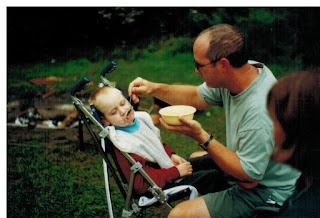
Feeding an infant with a cleft palate is a tricky exercise, Steven could not suck liquid from a nipple. It took some experimentation, but eventually, Steven began to gain weight using a squeeze bottle with a very soft nipple. However, he was very vulnerable to pulmonary aspiration- inhaling liquid into his lungs. Within weeks Steven suffered from lung infections due to aspiration, and resulting fevers. Due to his unique cleft and sinus configuration, formula and saliva also made it's way into his inner ears through his eustachian tubes, resulting in severe ear and sinus infections. During his first 4 years, Steven was taking antibiotics on a constant basis.

Twice in Steven's early life, I had to restrain him so the Pediatrician could perform lumbar punctures to rule out meningitis. At one point Steven had mastoiditis, in which the skull around his ear became infected, and had to be surgically scraped out.

Steven also suffered low threshold seizures once his temperature reached 102F (38.9C).

The early years were difficult ones.

Eventually, we learned that Steven has a very weak immune system, and for nearly 25 years now, he has received monthly IV infusions of the blood product Immuno-Gammaglobulin. Thankfully the IVIG has made his life much better and with only rare infections.

Another major medical challenge for Steven has been Esophageal and Intestinal muscle spasms. The muscles that move food and waste downward in his system can go into extremely painful spasms, which can result in food and acid from his stomach moving upward into his esophagus.

The discomfort of the acid reflux is not nearly as intense as the pain of the spasms themselves. However, through medication and careful monitoring Steven's suffering has been kept under control.

Steven began walking independently at the age of 8. He wears rigid orthotics to support weak feet and ankles (to below his knees). Steven also wears a back brace for support due to severe scoliosis (lateral spinal curve) and kyphosis (forward spinal curve).

He has several congenitally malformed vertebrae at the mid-spine and in his neck. In the last three years, Steven has begun suffering seizures, originally one every 6 months, and now on a two to three-month cycle. He is now taking anti-seizure medication for his epilepsy.

Sound:

Aside from what I have written so far, I have to acknowledge that we had two other children in our home who took on the challenge of Steven as bravely and as lovingly as we did. Steven went to a lot of his brother's hockey and soccer games, scouting meetings and events, Air Cadets, band concerts and school functions. But there was a divide that occurred in that one parent was caring for Steven while the other gave attention to his brothers. It was rarely Mom and Dad together even from an early stage. We were fortunate that my Mother was able to assist us at short notice, especially in the early years of Steven's life.

When Steven was just over two months old, we noticed that he was not responding to sound while we attended a local parade. We tested this ourselves by banging pots while he was awake or asleep, and he didn't even flinch. Later we had his hearing tested and it was discovered that he had very little hearing – if any at all. Suddenly our practiced techniques of communication were of no benefit to our youngest son. Talking, singing, laughter, reading, records and tapes were not going to benefit our baby. Steven's deafness was a hurdle that seemed unfair and daunting.

Fortunately, we made connections with preschool services for the deaf through the Provincial School for the Deaf in Milton, Ontario. For nearly three years Steven had an in-home Teacher who would come bi-weekly to spend a morning with Steven. This Teacher was deaf too, and she insisted that we begin ASL sign language classes immediately and begin signing with Steven (and with her) immediately. In-home sign language classes were arranged by the School, and we slowly began to improve our vocabulary.

Steven's brothers also picked up sign language from the lessons we were taking. We all worked really hard to include signing in our home.

However with everything else going on with our young family and Steven's poor health being a constant strain- our efforts to be really great at sign language never really happened. For the most part, we were identifying things for him, letting him know what might be coming next (time for supper, time for a bath, want a drink etc). It didn't help that Steven never really responded to our signing efforts. Eventually, he was fitted with hearing aids of the highest available amplification. It was described to us that with these hearing aids at their maximum setting and Steven seated beside a jet engine at its loudest – he might detect some sound. We eventually learned that the tiny chain of bones in Steven's inner ears are abnormally formed and do not transmit sound at all, so we stopped using the hearing aids.

When Steven was two years old we enrolled him in a preschool class for deaf children run by our local public school board. That this program existed at all was a tribute to many local parents of deaf children, who had advocated very strongly for such a program to be in existence. Steven was not a typical two-year-old. He had poor muscle tone, could barely roll over, could not stand, and could only bear weight on his feet while in a standing frame. Although we were signing constantly with him and he was in a signing classroom environment, Steven only rarely would attempt to sign back to us. His poor muscle coordination impeded his ability to sign. There were concerns that he might be injured by the more rowdy two-year-olds in the class, but in fact, the other children were very gentle with him and accepting. The teacher located a two-person standing frame with a play surface in-between the two frames. Steven would be strapped in at one end his classmates took turns at the other end. This is an example of accommodations that were made for Steven, and that the other children accepted him.

Light:

By this time Steven was wearing prescription eyeglasses, both to strengthen a “lazy eye” and to properly focus visual input to the back of his eyes. The lens over the strong eye was patched to force the weaker one to work harder.

It was suggested to us by his Teacher of the deaf that Steven's overall vision might be more impaired than our Optometrist was capable of detecting.

An appointment at the University of Waterloo's Low Vision Clinic verified this. Steven was not only deaf but legally blind as well. The point at which Steven's optic nerves connect to his eyes has significant abnormalities – congenital optic nerve atrophy.

The immediate result of this dual diagnosis was that the support network from The School for the Deaf had to immediately terminate support both for our family and for Steven.

Not only did we feel overwhelmed (again), but also abandoned.

Steven's new support network was from the W. Ross MacDonald School for the Blind and Deaf-Blind in Brantford, Ontario (WRMS). We quickly learned that having a dual-sensory disability does not come with an increase of support.

The “Deaf Community” in Ontario is large in population and has a strong political lobby. There was a lot of Government money streaming towards an agenda that would recognize ASL as the official language of the deaf, and also towards “Defining Deaf People as a Distinct Cultural Entity”. One of the major achievements of this lobby has been the emergence of ASL interpreters on television etc.

To be deaf-blind in Ontario is another thing altogether. The deaf-blind community is very small in number. Many deaf-blind people also have additional disabilities including intellectual disabilities. The political lobby for deaf-blind people in Ontario simply cannot compete for Government or private financial support on the scale that the deaf community does.

That being said, WRMS did provide in-home teacher support on a monthly basis, to provide us with ideas for communication, and to observe Steven's response to visual stimulus. We were also put in touch with The Canadian Deaf-Blind Association(CDBA) – a parent-initiated organization supporting people who are deaf-blind. The CDBA is centred in Brantford, and many members have attended WRMS – and many of the board members over the years have included teachers and principals from the school as well as parents of deaf-blind children.

The CDBA has played a key role in Steven's life and in supporting our family.

The first time we felt that we truly “belonged” was at a CDBA parent retreat weekend, where we met many families with deaf-blind children of all ages. Many of the affected individuals are “deaf-blind-plus” - having additional disabilities beyond the obvious.

About this time Steven stopped wearing glasses, as the “lazy eye” was determined to be his attempt to focus, and because his visual intake was so impaired by the optic nerve issues. Steven's best field of vision is within 12” (30cm) of his face. He can detect movement up to 10 feet (3m). He also seems to be able to see things better by looking down and to the right or left. He is also able to distinguish colours.

School and beyond:

Steven remained in the public school system but attended a class for children with a variety of special needs. He and his class teacher were supported by the visits of the specialist teachers for the deaf-blind from WRMS, through their monthly visits during the school year.

You may be familiar with Interpreters for the Deaf – someone who can translate spoken words to sign language for the hearing impaired. A Deaf-Blind person is supported by an Intervenor, whose purpose is to enable a deaf-blind person to live independently, and to function in society. They provide communication through whatever means work best for that individual. The Intervention Model was founded through the work of Annie Sullivan, the person who enabled deaf-blind pioneer Helen Keller.

Intervention is a one-to-one support model, and Steven received Intervention during his primary and secondary school years.

During the summer vacation months, CDBA was able to provide funding to bridge in-home Intervention for Steven, intended to carry in-school fundamentals of communication to our home setting. We generally hired and trained university students for this role.

When Steven was 13, we were encouraged to have him attend WRMS's Residential School Program. This meant he would leave on a bus Sunday nights and return home Friday afternoons. He was housed in a dorm with other deaf-blind students and attended the school during the day. It was a very difficult decision for us to “let go” so Steven could attend Residential School. Keep in mind that then as now, Steven is very much like an infant. He is diapered, does not self-feed, and requires one-to-one support for all functions of his existence. He had one-to-one Intervention during the school day but shared support with other students while in residence.

Sadly Steven's health declined during the one semester he was there, to the point that he could not return to the school. Looking back, I realize that letting him go for that one semester provided us with a glimmer of hope for his future – we had decided that he would not live with us forever, that someday we would let him go.

Steven's high school years were spent in a Roman Catholic School. The support system was pretty much the same through those years, with the key exception that the Catholic system had a lot better funding, equipment, and a much more healthy attitude towards the individuals they supported.

When Steven was 19, we were contacted by CDBA with the news that there was an opening for him at a group home for the deaf-blind in Brantford. We knew that we could not turn down this opportunity, as openings with such organizations rarely occurred.

Steven stayed at that the Lions McInnes House group home for three years and then moved into a newly constructed apartment-style complex for the deaf-blind in Paris, Ontario.


A Word on Communication:

We communicate with Steven using ASL signs or signs adapted on his body, keeping signs simple, and within his field of vision. Steven also has used visual concrete cues, pictures, and tactile cues. He is a very easy-going person and has pretty much figured out the routines of his life.

Steven has ways of communicating things to us. He has a beautiful smile and a laugh that brightens any room. He will stamp his feet if he is tired of walking. He purses his lips and does a sucking motion if he is thirsty or hungry. He will yell and wring his hands if he is in distress from an esophageal spasm, and might also tap his chin or throat. He will clap if something excites him.

The most difficult issue with communication has been that Steven cannot describe to us where or how he is hurting. Many doctors and specialists have found this to be a difficult problem in diagnosis, and they have to rely on our observations of how Steven is acting in order to seek out the source of the problem(s).


 Finding a place:

As you can imagine, much of our time raising Steven required us to be advocates for his rights, his health, his education, and his place in our society. The process had many positives and many negatives, but in the end, I feel we did the best that anyone could have done for Steven.

Over the years we have learned so much through connections with people and organizations. It was a remarkable evening when Stephanie St. Pierre called to introduce herself to us, and to share that there were other people with the same chromosome anomaly as Steven. Her connection with us helped diminish our feeling of being alone and has led to a lasting friendship.

Others that have played a role have been many, but include:
  • The Canadian National Institute for the Blind
  • Community Living Ontario
  • Niagara Deaf and Hard of Hearing Association
  • Niagara Children's Center
  • Lake Joseph Camp for the Blind
  • Lions McIinnes House
  • McMaster Children's Hospital
  • Canadian Deaf-Blind Association (Sensity)
It was only through a lot of networking that we found the organization that best supported Steven and ourselves, and where Steven belonged.

For us, the most important support network came about because of the “bonus” disabilities of deaf-blindness. Currently, Steven lives in a small apartment in Paris, Ontario, owned and operated by Sensity (formerly CDBA), and is supported 24-7 with Intervention.

The Canadian Deaf-Blind Association(CDBA) re-branded two years ago and is now named Sensity – Deaf-Blind and Sensory Support Network of Canada.

Scott Richards, Steven's dad.

Happiness = Flexibility

They say happiness is a product of so many things…. The 4 Agreement System,  being content with what you have….. Biblical but also a worldly...